|

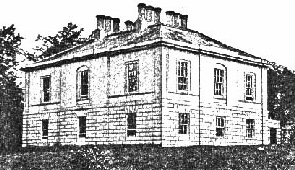
Hannahfield House
For
me, Hannahfield was probably the most intriguing of
all the stories that I have been told about our part
of Clan Hannay. Since I was a small boy I had heard
the story of a large house in Scotland that had
belonged to a distant relative of ours, and how we
had fought and failed to re possess it from the
state.
When I
told my father about my plans to put our bit of
history on the web, he produced many documents and
photographs about Hannahfield, and I finally
understood the full story. My fathers cousin also
has the "History" bug and I decided to use her
account of the rise and fall of Hannahfield. The
account that follows was originally written for the
Clan Hannay news letter (although I am not sure
exactly how far back this was written, it was around
1975).
The Hannah's of
Hannahfield, Dumfries, Scotland.
By Miss Margaret Hudson, New Malden, Surrey.
The Hannah's of Hannahfield - it sounds like the
title of an old Anna Neagle film or a novel by
Thomas Armstrong. In fact, there was really only one
Hannah of Hannahfield, and this account is as much
an attempt to show the fascination of tracing family
history as it is a story of The Hannah's of
Dumfries.
I heard of our clan society from a Hannah cousin (my
Dad! :Stuart) and he lent me a copy of a family tree
which had been prepared in support of a petition to
the crown in 1870 by our great grandfather for the
return of the property in Dumfries called
Hannahfield. I already knew of this and had spent a
short holiday in South West Scotland, when I
discovered the family grave in St Micheal's,
Dumfries, and tried to locate Hannahfield in the
area of Kingholm.
I had no time to visit the local library in search
of clues or to go as far as Edinburgh to visit the
Scottish Record Office. I paid a brief visit to the
Burgh Museum, which yielded no information. I am
sorry to say that although in our travels we passed
very near Sorbie, I knew nothing of its existence.
The first Hannah on our family tree was John, born
in the 17th century. He had two sons and one of them
was baptised at Penningham in 1696. This is the
first place mentioned and after that only places of
burial are named. These two sons each had (amongst
other children) a son, and these two cousins,
Alexander and Robert, married sisters - Rachel and
Agnes Blount. Of these two families, Alexanders at
some time went to Huddersfield (please see 'The
Hannah's of Huddersfield' for more about this)and
Roberts lived in Dumfries.
The Story of
Hannahfield.
Robert and Agnes had a son, John, born in 1761, and
he became the owner of the Hannahfield estate. He
died unmarried and it is Alexander (mentioned above)
who is my ancestor. John was born at a time when
economic conditions in Scotland were improving and
the country was enjoying peace for the first time in
centuries. Agriculture, industry and transport
systems were developing, literature, art and
architecture began to flourish, and many Scotsmen
made fortunes in the colonies. John Hannah was once
such and owned an estate in Jamaica called Hannah's
Town (please see the "Hannah's in Jamaica" page for
more about this). According to the book "Memorials
of St Micheals", he amassed a fortune in the West
Indies. It has been suggested that he might be the
originator of the Antigua 1/4d token coin in 1836
(attributed to Hannah & Coltart) but Antigua is a
good way from Jamaica and there is no firm evidence
of a link.
We know more about the Dumfries property and its
loss to the family. Part of it (called Kingholm) was
bought from the Burgh in about 1827, at a time when
the council was in financial difficulties. Another
part of the property had the attractive name of
"Cherry Trees" but the name of the whole was changed
by its doubtless proud owner to "Hannahfield". He
apparently said that he intended a Hannah to live
there after his death, and his only relative with
that name was his cousin (a few times removed), my
great, great grandfather. He did however have a
nephew, his sisters son, Thomas Wood, and it was he
who inherited under Scottish law when John died at
the age of 80 without leaving a will. Thomas Wood
had no children and at the death of his widow in
1868, the property passed to the crown.
Kingholm was the place where the traditional
competition by the Trades for the "Siller" gun given
by James VI was held and the burgh was anxious to
regain this historic site. They petitioned Queen
Victoria to re grant them the land, and this was
done in 1873.
The "Hannahfield" monument in St Micheals
churchyard, described in the memorials as "a stately
modern (IE in the 1870's) monument in the Grecian
style" commemorates all these people, including
Johns parents, Robert Hannah and Agnes Blount, the
inscription reads.
"This
monument was erected by John Hannah of Hannahfield,
formerly of Kingston, Jamaica, in memory of Agnes
Blount, his mother, who died 3rd February 1798 aged
74 years. Robert Hannah, his father, who died 17th
September 1799, aged 68 years. Robert Hannah, his
brother, who died 7th September, 1770, aged 9
months. Agnes Hannah, his sister, who died, 20th May
1800, aged 36 years. Helen Hannah, his sister, who
died 28th November 1831, aged 66 years. Also of the
said John Hannah who died at Hannahfield on the 20th
July 1841 in the 80th year of his age."
It is
interesting to see that Thomas Wood's brother, James
was buried at Kingston, Jamaica at the age of 19,
and one surmises that he was out there in connection
with his uncle's Jamaican interest's. Some of the
Blount family, who were cousins of the Hannah's,
also died in Jamaica, according to the other
monuments.
A second visit to Dumfries (around 1975) in search
of Hannahfield, proved more fruitful. This time I
had written to the local library to ask if they had
any record of the house called Hannahfield. Their
reply enclosed a map showing that it was now part of
Crichton Royal Hospital and an extract from "The
Chronicles of Crichton Royal" by C.C. Easterbrook
(1940) saying "Hannahfield House, with gardens and
grounds of 8 acres, also adjoining the institution
property, is leased from the crown (war office) at
Whitsunday for 7 years, at a rent of £65 p.a and is
used as a residence for several First House
Gentlemen". This was the first time I had heard what
had happened to the house.
On
my previous visit I had searched the wrong area and,
in fact, the house was difficult to find, as it is
now called "Ladyfield West". I found Cherry Trees, a
row of extremely plain dwellings, which I later
discovered had earlier been occupied by permanent
military personnel. As the property belonged to
Crichton Royal, I crossed the road to the main
building and called at the enquiry desk. It felt
rather foolish to say that I was enquiring about an
ancestral home but the staff were extremely helpful
and arranged for the superintendent of Ladyfield
West to take me on a tour of the house. It is now a
home for disturbed children and has been stripped of
furniture, carpets, etc. Its best feature is the
entrance hall, with an alcove in the centre and
pillars either side, in the classic style, the walls
having been painted a deep blue. The house is built
in the Georgian style, with a flight of steps to the
front door, as the ground slopes downwards to the
rear of the building.
It is of stucco and ashlar, two storeys high, and of
symmetrical design. I gathered that even the chimney
stacks had been removed, to the annoyance of one of
the staff who took an interest in this old house.
What is now called Hannahfield Hall is in fact an
old Army equipment store and is also part of the
childrens unit of the hospital.
As no photographs of the house appeared to exist, I
called at the Burgh Museum, but Mr Truckell, the
curator, had nothing but photographs of military
personnel taken in the grounds. He suggested I wrote
to the hospital administration and asked if they had
any pictures of the house. This I did on my return
home and later recieved a very interesting letter
with details of the house and grounds from the
hospital secretary, Mr G B Turner, who had just
retired. He also sent me a picture of the rear of
the house and extracts from McDowells "History of
Dumfries" which I had studied in Dumfries library.
The first mention of Hannahfield in the history
books was that Kingholm was bought on the 19th July,
1827, by Mr John Hannah for £6,300 and a footnote to
this said that in 1712 the same property was left to
John McNish, Deacon of the weavers, for "Twinty-Two
pounds sterling yearly"(yes that is spelt correctly
despite what spell check says: Stuart).
Among the more interesting points was the fact that
when Queen Victoria's sanction was given in 1873 to
the gifting of the whole of Hannahfield for the
purpose of a public park, there was great rejoicing
"a cake and wine banquet , clanging of bells, and
crackers in the street at night"! Unfortunately
after delays over the scheme, which also included
the provision of bursaries for education, a change
of Government led to the land being gifted by the
crown to the war department in 1875, and it was used
by the military until after the first world war. The
house was first leased from the war department in
1889 and in 1929 the house and estate of 33 acres
was bought from the war department.
The Hannahfield burseries created in 1879 with
£9,500 of the Hannahfield estate are still awarded.
An examination in English and general knowledge is
held each year throughout Dumfriesshire,
Wigtownshire and the Stewartry of Kirkcudbright and
the results of this examination, together with the
individuals school record, leads to the award of
three bursaries of £70 per annum to University or
College. These bursaries run for 3 years as
necessary to complete the course of training.
Mr Turners letter included his summary of the
history of Hannahfield house and estate and a map
marked with the boundaries and various buildings. He
said that in his early days (he was born very near
the estate) the grounds were beautifully kept. There
is a walled garden and an arbour with sandstone
pillars and canopy. It was interesting to me that
Thomas Wood, John Hannah's nephew, was the gardener
there before he inherited it in 1841. The house
appears in a list of scheduled buildings (category
B) but I noticed that the gateposts (Category C) had
been knocked down a few years ago to widen the
entrance. One wonders what will eventually happen to
the house?
Footnote (Stuart Hannah).
I am
very grateful to Margaret for all of her hard
effort, the history of Hannahfield is one of great
hopes for the estate and its inheritors, hopes which
were unfulfilled, and now there is no hope of a
Hannah ever again living in Hannahfield (unless I
win the National Lottery!). I have recently
discovered pictures of Hannahfield House (Ladyfield
West as it is known now) which I have asked for
permission to display here, the house is in a
terrible state of repair and this is a real tragedy.
One last item which may be of interest is the
petition for the return of Hannahfield. I have an
original copy which I intend to get scanned in and I
will add it here as soon as I can.
Stuart C Hannah, January 7th 2010
|